Featured

My First Blog Post

I chose to join the urban design network for several reasons. First, Urban design is my primary interest in regards to landscape architecture. Second, this network corresponds well with my studio project. My classmate and I have been given permission to enter a design competition for studio credit. The competition in question is an open ended project that aims to create and iconic structure/landscape in San Jose. Think Eiffel Tower, but for tech capital of the world. The design must be both celebratory of Silicon Valley’s deep roots and impressive/unique enough to be seen as an international landmark. On the PPN’s page, I saw an article about reducing street sizes in favor of greater pedestrian/biking opportunities. The project is a near mile of linear street improvements in Memphis, TN. Some of these improvements include; reducing the number of lanes from 5 to 3, adding wheel stops and large bike lanes for safer bicycle travel, and creating bump outs/distinguished paving for a safer and more interesting pedestrian experience. These ideas are highly valued by me because of their profound effects for a relatively low cost. I hope to use some of these ideas in my upcoming project in an effort to emphasize the importance of the proposed design and create a greater level of depth/safety in the landscape.

Hello World.

Blog Post #4

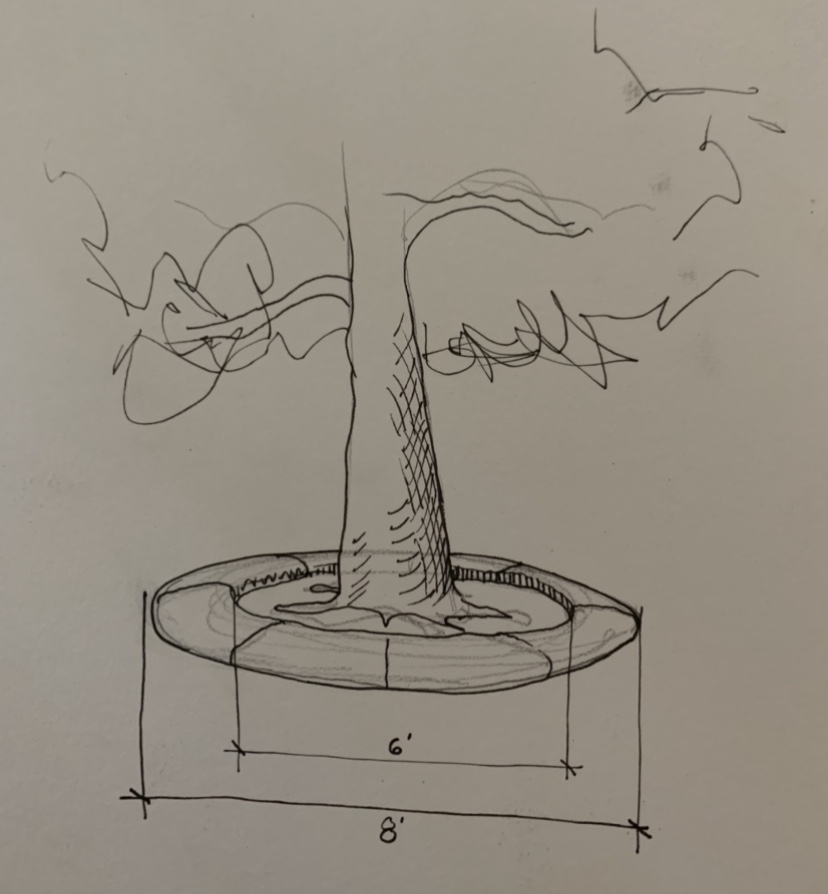
            This week I read an article by James Urban that spoke about the importance of tree growth in urban environments. The article stated that most urban trees are neglected or poorly cited for several reasons. This primary and most important issue to address is an inadequate volume of soil surrounding the tree. The article states that 1000ftis the minimum soil volume needed by a large tree need for healthy growth, but often times that might not be enough. More often, a large tree will need upwards of 5000ft to grow in its natural, un-stunted form. This may sound like an absurd cost to any project, which it almost certainly is, however the article states that often times, the existing site soil is already a high enough quality to sustain trees. The principal issue is that generally the sheer space is not allocated. The second and near equally important issue is proper space left around the base of the tree. When 3d modeling/designing, trees are often ‘planted’ with paving right up to the base of trunk. In the real world, the scenario will likely end in stunted growth of the tree. It is important to allow at least roughly 6-9’ of space around the trunk. 40” for diameter of the trunk to swell and 3-6’ for surface roots to place themselves. However, with careful planning, surface roots can be diverted underground. This is pertinent to my studio project because of the large amount of trees (146 to be precise) that are planned to be in tree grates surrounded by paving. Knowing this, I may not have time do exact calculations, but I will definitely consider the allocated root space for each tree more seriously. This will give my studio project an added level of realism and further prepare me for professional practice when mistakes like this will not just result in a bad grade, they will cost 1000s of dollars. 

Sketch of my proposed tree ground planters, made from a rounded concrete curb surrounded by paving.

Blog Post #3

This week I read an article by a man named David Barth who developed a checklist of design outcomes that, when used in conjunction, create what he calls a High Performance Public Space (HPPS). The concept is rather simple but extremely effective. It breaks down the criteria into three main groups, economic, environmental, and social. The overall premise of this concept is that a public scape cannot adequately serve its community if it does not achieve a certain level of connectedness to its surrounding context. For example, under the economic section of criteria, there is a statement saying that a public space must sustain or increase the value of the surrounding neighborhood. Another under the economics section states that a public space must directly/indirectly sustain or create good living wage jobs. However the most interesting section to me is the social section. Some of the primary concerns in this set of criteria are the level of use and community involvement created by the public space. For example, one of the criteria states that a public space should encourage the physical engagement of activities. Another states that the public space should bleed into the landscape, using its connective paths to integrate it into the surrounding area. Finally the environmental criteria are pretty much the standard green building criteria. Such as, the space should be a net carbon sink and should educate the users of the space about the local ecology. 

I think the ultimate strength of these criteria is there vagueness and flexibility. This allows for open interpretations of the ideas and encourages creative and culturally relevant thought. Two spaces in different neighborhoods may meet the criteria in different ways and both be successful in their own rights. 

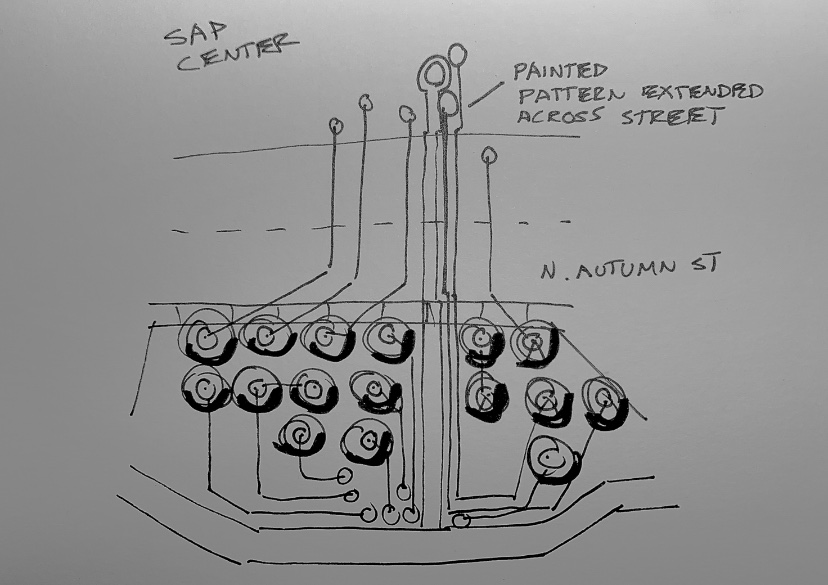
For use in my studio project, I thought the issue of connective paths that bleed out of the space was a very interesting idea, I plan to use my paving pattern design to help increase connectivity between the SAP center and my site. 

Rough sketch of how the ground plane paint will extend over into the street.

Blog Post #2 Urban Design PPN

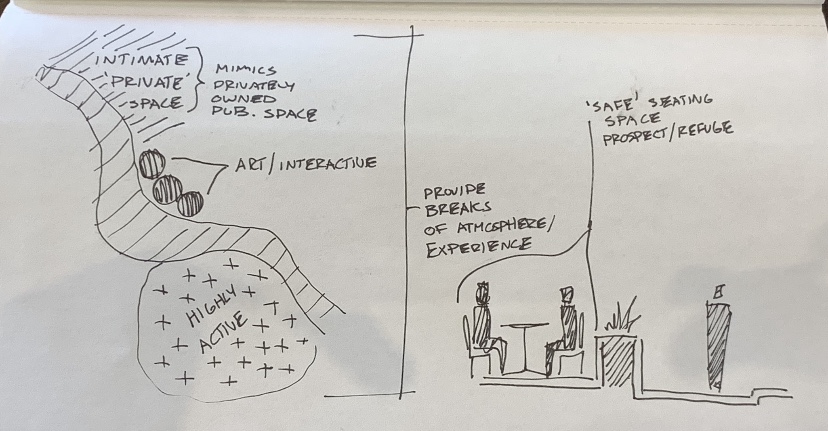
This week I read an article about the importance of privately owned public plazas in urban spaces. The article talks about the recent development boom in Denver and how the existing public infrastructure is under strain because of the use increase. The article states that about 30% of public urban space is privately owned and is vital to the health and connectivity of the urban fabric. The article also talks about William Whyte’s work and studies related to urban spaces and gives reference to a particular New York plaza that he studies in “Social life of Small Urban spaces”. There was a push to build up in New York in the 70’s and 80’s. City planners created incentives to increase the amount of public space and sunlight present on the street level by allowing developers to build higher if they set back their building from the street and added small plazas. This type of plaza is super important because they are more likely to directly interact with the street, creating a more vibrant streetscape. They are also important because they tend to be more intimate/quiet spaces that give pedestrians a rest from the hustle and bustle of the city. The article states that the main drawback to privately owned, public space is that they are subject to change more rapidly by developers and building owners. Because they are privately owned and those incentives they were built with are no longer applicable, there is no legal obligation to maintain and perpetuate this type of space. This could have potentially devastating effects on neighborhoods that rely on these type of spaces, furthermore, although they are privately owned spaces, they benefit the public and should be highly valued and maintained. 

Some ideas for my studio design I pulled from the article.

Design a site like this with WordPress.com
Get started