This week I read an article by a man named David Barth who developed a checklist of design outcomes that, when used in conjunction, create what he calls a High Performance Public Space (HPPS). The concept is rather simple but extremely effective. It breaks down the criteria into three main groups, economic, environmental, and social. The overall premise of this concept is that a public scape cannot adequately serve its community if it does not achieve a certain level of connectedness to its surrounding context. For example, under the economic section of criteria, there is a statement saying that a public space must sustain or increase the value of the surrounding neighborhood. Another under the economics section states that a public space must directly/indirectly sustain or create good living wage jobs. However the most interesting section to me is the social section. Some of the primary concerns in this set of criteria are the level of use and community involvement created by the public space. For example, one of the criteria states that a public space should encourage the physical engagement of activities. Another states that the public space should bleed into the landscape, using its connective paths to integrate it into the surrounding area. Finally the environmental criteria are pretty much the standard green building criteria. Such as, the space should be a net carbon sink and should educate the users of the space about the local ecology.
I think the ultimate strength of these criteria is there vagueness and flexibility. This allows for open interpretations of the ideas and encourages creative and culturally relevant thought. Two spaces in different neighborhoods may meet the criteria in different ways and both be successful in their own rights.
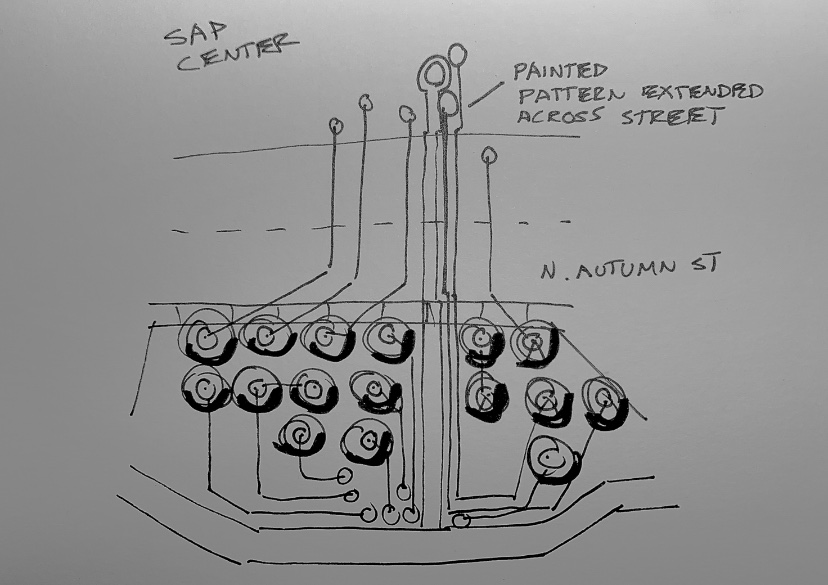
For use in my studio project, I thought the issue of connective paths that bleed out of the space was a very interesting idea, I plan to use my paving pattern design to help increase connectivity between the SAP center and my site.
 Scroll Down.